Myalgic Encephalomyelitis (/Chronic Fatigue Syndrome).
I’m sitting in the clinic’s patient room waiting for the doctor with a mix of hope and dread.
Hope that he’ll tell me what’s wrong with me. Dread that he won’t believe me or he’ll misdiagnose me like the many other medical practitioners.
A few believed me until all their regular tests—blood tests, ultrasounds, CT scans, MRIs—came back normal or were further investigated to the point of “not likely the cause of chronic fatigue.”
Several doctors had me complete a depression/anxiety questionnaire and when those indicated I didn’t have either, they told me to “eat right, exercise, do this insomnia workshop”.
“Even when I seem to have slept enough, I wake up exhausted and am often more tired after exercise.” I’d feebly offered.
“Start slow and build up. You’ll feel better if you push yourself a little.”
So, I do. The fatigue is chronic, but intermittent, after all.
I do the insomnia webinar. I develop seven new habits to help with sleep. They do help with sleep. But I still don’t wake up feeling rested, and instead continue to feel mentally and physically exhausted more days than not.
I drag myself to the gym (in my building) after years of varied attempts and start glacier slow. No weights. One set. Low reps. That goes OK, but after a few weeks, I notice it’s taking me longer to recover my energy even though my muscles aren’t really sore. And in that time, I’m walking less in the real world, ordering groceries instead of walking to the grocery store (seven minutes from me), and feeling less social and more sluggish.
I think, “I’m just burnt out because I overdid it building the new program.”
After a trip to see family on the Island, running on caffeine every day to get through it, I land on the sofa for a week, completely unable to think, work, meet friends, exercise, get dressed, or even listen to an informational audiobook.
By the time my online stock options webinar rolls around, and because I completed it once before years ago, I feel recovered enough to follow along (in PJs). The information is fascinating, but my brain is grasping to keep up. (It was much easier the first time. WTF, brain, smarten up!)
After the workshop, another week on the couch, mentally and physically drained. I scroll funny shorts and make silly Snaps.
Back at the doctor’s office…
He’s asking me a bunch of questions. Many I’ve heard numerous times. But he’s also asking me new questions I haven’t heard, and actually listening to my answers with what seems like genuine interest.
“Does exercise energize you or tire you?”
“Usually, it tires me. But I can sometimes walk longer distances.”
“How many steps a day do you walk on average?”
I pause, not sure how to answer.
“On average? It really depends. Some days I can walk over 10,000 steps but then I’ll hardly move for several days, so it’s hard to say.”
He makes a note, and I tell him my gym experience ending with, “The last time I tried [to go to the gym] I lasted 10 minutes and had to have a nap at 10AM.”
He nods, “How’s your sleep?”
“Better after the CBT-I workshop. I do most of the protocols it recommended, but still wake up some nights for an hour or so but am able to go back to sleep and get enough hours, I think.” I forget to add that I always wake up feeling unrested, no matter how many hours I’ve slept. (Or maybe I did mention it.)
He asks, “Does anything help with energy?”
“Caffeine. But it tickles my bladder and increases insomnia so I use it only when absolutely necessary.”
“Do you know if you snore? Has anyone told you…” he trails off, but I know what he means: do I have a bed buddy (or roommate, perhaps).
I want to tell him I’ve been single for over a decade because I’m too exhausted to even think about dating, never mind a relationship.
Instead, I let him know, “I used to have sleep apnea but I did everything I could to fix it and in my last overnight sleep study, I had only mild sleep apnea. I travelled with girlfriends a few years ago and they told me I sleep ‘soundlessly’.” I want to tell him that in order to manage these trips I have to pace myself, take daily naps, and not go out in the evenings, but he’s already on the next set of questions.
“Brain fog? …difficulty concentrating? …memory problems?”
“No, maybe, I can usually type my thoughts better than speak them.” Shit, I should have used ‘articulate.’ (Later, I realize these answers are all ‘yes’ but I’ve structured my life around not requiring those attributes daily. I have needed only an hour or two one or two days a week to focus, concentrate, and—confession—use a teleprompter.)
“Joint pain?”
I contradict myself, “Not really. Neck and lower back.”
“Sensitivity to light? …sound? …medications? …chemicals?…”
Yes, yes, yes, yes…
“Frequent urination? …heart palpitations?”
“No, yes.”
And so it goes.
Somewhere in the conversation I give him another example, “I went out for an afternoon happy hour with some girlfriends—less than three hours—and I was incapacitated for four days after. I never plan dinners out or activities after dinner because I know I won’t have the energy.” I forget to add that I must include days before and after any social excursion to prep and to recover.
In the end, I blurt out, “I’m frustrated I don’t have a normal life anymore. I used to be dynamic, I was fit, I worked 80 hours a week for decades because I loved it. This year, I’ve been barely able to work 5-10 hours/week erratically. I’ve had to hire so many people to help with my business it’s barely making a profit. But I can’t do more, I can’t even do what I’m doing anymore and I don’t know what else I can do given my limitations and no one has been able to help me.” I take a deep breath, my voice catches in frustration and I feel my eyes begin to well.
He says I have “the hallmark symptoms of ME/CFS” then goes on to explain. Something about brain and nervous system inflammation, no known cure; cause may be a virus (mono, EBV, Lyme—I’ve had two. Untreated.). Symptom management: pacing.
But now I’m leaking from my orbital sockets because someone—an actual mainstream medical professional—believes me.
I sniff, and he retrieves a tissue for me. While I’m looking down to dab my nose, I notice his stylish socks and coordinated outfit and briefly wonder if he’s single. He understands, after all. But I’d need a whole new PJ wardrobe because that’s what I live in, people! Oh yeah, plus not every well-dressed, educated man is going to want a Princess Potato.
When I’ve collected myself he says I’ll need to complete a depression/anxiety questionnaire as “they are often common in people with ME/CFS”.
I sigh and dab my eyes. Of course they are.
I say, “I will, but I don’t think I have depression, I want to do things, I want to have a life! I’m frustrated not depressed.”
He says, “You mentioned you startle easily and feel like your nervous system is on edge?”
I concede, “Yes.”
He says, “Well, just fill out the form. It will help us know if we need to refer you to a psychiatrist.”
Oh, man. Really? But, OK, if my nervous system is that far off, I’ll do it.
I say, “OK, at this point, I’m desperate.”
We end the meeting with him giving me some official medical websites to get more information on ME/CFS but to not overdo it, “Don’t read all the articles at once”.
I go home and immediately break my promise to heed his advice, reading several articles, joining the ME/CFS support group and reaching out to a friend who has a friend who has ME/CFS because, no offence but you don’t get it unless you’re in it.
Years ago, someone asked me what I meant when I kept saying I “don’t have the energy” and I tried to explain, “Well, it’s like if you stay up all night and the next day and you’re barely keeping your eyes open with toothpicks and you couldn’t lift a paper bag of cotton balls for a million dollars. But it feels like that after a full night’s sleep. Often. Most days. Doing normal things. Sometimes, you can rally, but you’ll pay for it.”
Biologically speaking, it’s a similar feeling to having the flu. In fact, the same brain mechanisms are at play. Something about brain glia cells.
Follow Up
I haven’t heard back about the psychiatrist (will follow up), and I don’t know what the next steps are. For now, I’m managing my health and energy (but for real this time—I simply don’t have the capacity not to). Managing my energy looks like accounting. Even showers are budgeted for, because a shower isn’t one task, it’s a dozen: undress, stand, scrub, dry off, brush out my hair, get dressed again. And the whole sequence has to be paid for, and most days the budget covers washing my hair or making dinner, not both. Getting “dressed dressed” is reserved for filming days and outings. The PJ choice isn’t me giving up, it’s a line item.
As for work, I had already recorded and scheduled some content to be published in the fall, but beyond that I don’t know what the future will look like or what level of work, if any, I’ll be able to sustain. For someone who loves work, has a strong internal drive to be productive, and grew up following Tony Robbins with Brian Tracy’s ’21 Steps to Success’ memorized before high school graduation, that’s a difficult sentence to write, but it’s true.
I may need a new direction (not nude erection—sorry, had to) in life. Whatever it is, it’ll have to be one my body co-signs on. I’ll cross that bridge when I get to it. Slowly. With Naps R Us.
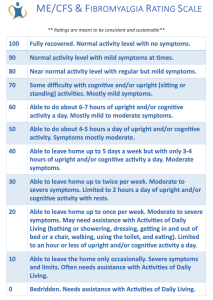
Please share this blog and/or the following links with a person you care about who may have undiagnosed ME/CFS symptoms. The rating scale is particularly interesting. I have been steadily declining and seem to have plateaued at 30%. I hope rest and pacing will at least hold the line, and if it buys back some function over time, I’ll gratefully take it.
Also, I have received many concerned and thoughtful emails, and while I wish I had the energy to reply to them all, well, I can’t, but thank you so much and please know that I will make an effort to reply to public comments here on my blog where others may benefit. Thank you for understanding.
 These are excellent articles explaining why the fatigue experienced with ME/CFS is fundamentally different from the tiredness healthy people experience (hint: like borrowing from a loanshark, it’s the interest and penalties that kill.): https://cfsselfhelp.org/library/post-exertional-malaise and https://www.mecfssandiego.com/mecfs-resources/mecfsBankAccount
https://cfsselfhelp.org/library/about-chronic-fatigue-syndrome
https://cfsselfhelp.org/pacing-tutorial/finding-your-limits
https://cfsselfhelp.org/files/Rating_Scale_2024.pdf
https://www.mefm.bc.ca/dispelling-myths
This was a serious post, so here are some Snaps to lighten it up.
